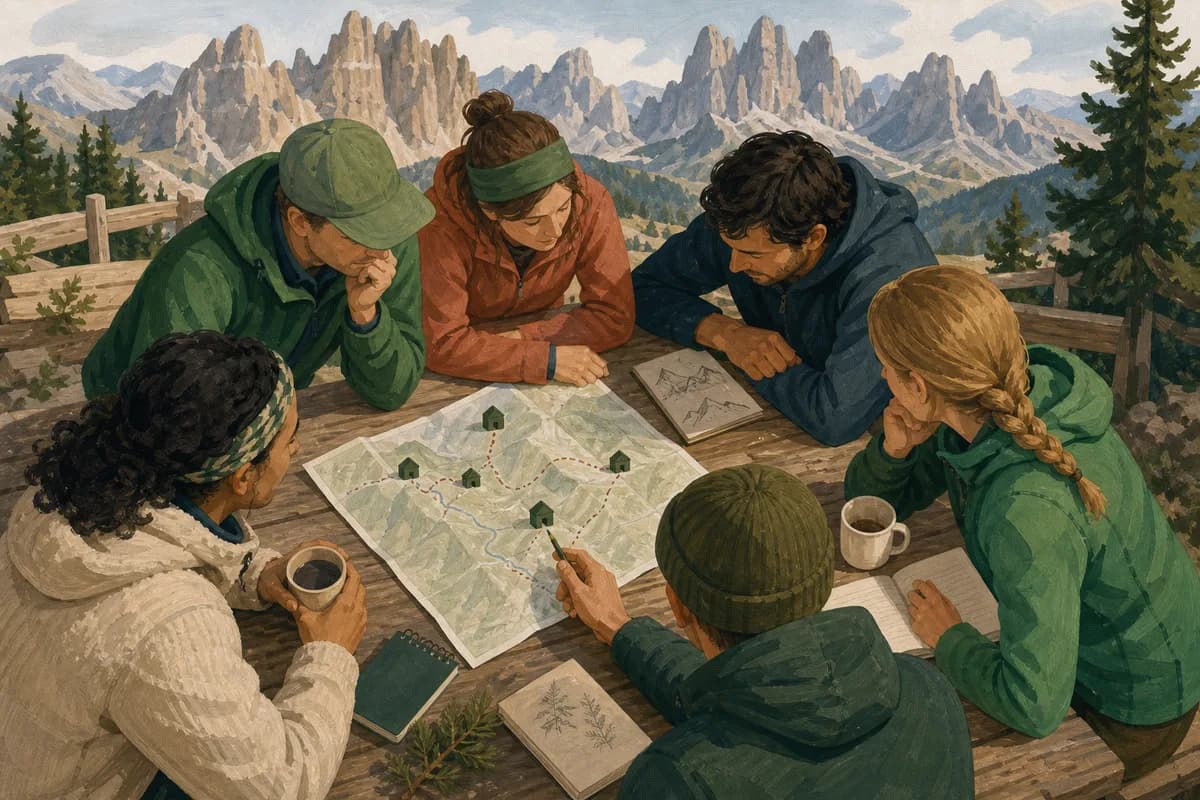
Booking for a group is not the solo booking process multiplied by six. Availability may disappear when the party-size selector changes, room assignments may split the party, and one unpaid deposit can hold up the entire chain.
The group needs a booking protocol before anyone opens a reservation form.
Freeze the real party size
Ask every participant for a firm yes or no, not an expression of interest. Record:
- Full name as required for reservations.
- Whether the person accepts dormitory accommodation.
- Dietary information that a hut specifically requests.
- Alpine-club membership only where the hut asks for it.
- The maximum deposit each person authorizes the booker to pay.
Do not reduce the party size on a calendar merely to make a date appear. A result for two hikers is not evidence that six can stay.
Appoint one booking lead
One person should own the itinerary ledger and confirmation archive. Other people can monitor individual huts, but every action should be reported to the same record before another reservation is made.
For each payment, record who paid, how much the group owes that person, and whether the amount is refundable under the hut's displayed terms.
Test the exact group on every system
Hut systems expose capacity differently. Some show a remaining-bed count, some return only a free-or-full result, and some publish no online availability.
Rifugio Nuvolau states that standard-price group bookings are limited to eight people and that reservations require a 40% deposit. That is one hut's published rule, not a rule for the trail. Read every booking page independently.
Write the eight nights down in route order, then open each official booking destination and repeat the check with the exact party size.
Decide whether splitting is acceptable
Before booking, agree on what “together” means:
- Everyone in the same hut, regardless of room.
- Separate dorms are acceptable.
- A split across two nearby accommodations is acceptable only after the walking plan is verified.
- The group will not split overnight.
Without this decision, one person may book the last two beds and assume the rest will solve themselves.
Send requests that can be answered quickly
For a hut that accepts enquiries, use a compact message:
Hello, we are a group of six walking the Alta Via 1. We would arrive on 18 July and leave on 19 July. Do you have accommodation for all six, and what is required to confirm the reservation? Dormitory beds are acceptable.
Change the details, but keep the structure: exact date, exact party, accommodation flexibility, and one confirmation question.
Treat partial confirmation as a risk
If a hut can accept only part of the group, do not pay automatically. First calculate what the split does to both adjacent walking days and whether the remaining hikers have a confirmed alternative.
An official waiting list can be useful, but it is not accommodation. Keep the night marked unresolved.
Coordinate deposits and cancellation decisions
Before the booking lead pays:
- Share the amount and cancellation terms with the group.
- Set a deadline for objections.
- Record approval.
- Save the payment receipt and confirmation.
- Recheck the dates on the adjacent nights.
If somebody drops out, contact the hut through its official channel rather than assuming the name or bed can be transferred.
Use flexibility where it helps most
Groups often have fewer available dates than solo hikers. If possible, keep the start date flexible until the most constrained night is confirmed. The constraint-first booking method is especially valuable for parties larger than two.
Sources
- Rifugio Nuvolau booking page — official maximum standard-price group size, deposit, and booking conditions; reviewed 2026-08-04.
- Rifugio Lagazuoi official site — official booking and availability destination; reviewed 2026-08-04.
- Rifugio Fanes reservation page — official hut reservation destination; reviewed 2026-08-04.