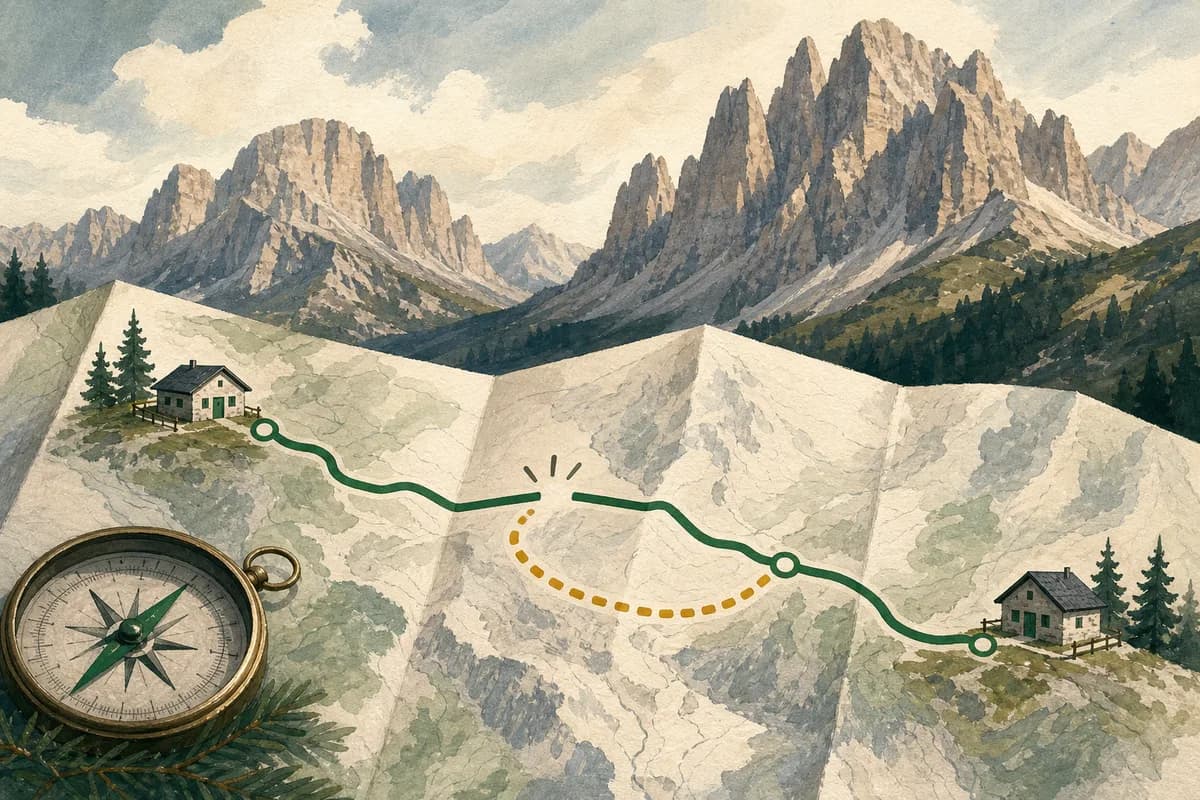
An Alta Via 1 itinerary is broken when one or more nights cannot be confirmed without making the surrounding walking days unrealistic. The right response is not to collect random available beds. It is to repair the chain while protecting the route, the group, and the reservations already paid for.
Work through these steps in order.
1. Verify what the result actually means
Start on the hut's official booking destination. A cached result can be old, a calendar can show availability for one person but not your party, and some huts publish no online calendar at all.
On HutPass, look at the age of the hut's last successful check. “No answer” means the system did not provide a usable answer. It does not mean the hut has space, and it does not mean the hut is full.
Read How to Interpret Alta Via 1 Hut Availability before changing a paid itinerary based on one status label.
2. Shift the whole start date
If flights and endpoint hotels are still flexible, test nearby start dates across the full itinerary before changing individual overnight stops. Moving the start by one day moves every hut night together and can resolve the gap without changing the walking plan.
Compare complete sequences, not isolated dates. A shift that fixes night three but breaks nights five and six is not an improvement.
3. Check legitimate cancellation openings
Some booking systems return cancelled space directly to the calendar. Rifugio Nuvolau explicitly says its online availability changes automatically when somebody cancels.
Use the official system rather than buying or informally transferring a reservation from a stranger. A name, deposit, or room allocation may not be transferable.
Set a reasonable check rhythm. Constant refreshing does not create more cancellations and can turn planning into a full-time job.
4. Ask the hut a precise question
If the official website provides a contact route, ask about the exact night and party size. Mention that you are walking the Alta Via 1 and name the huts before and after, because that makes the logistical constraint clear.
Ask one answerable question: whether the hut can accommodate the party, place you on an official waiting list, or suggest its own booking procedure. Do not treat silence as confirmation.
5. Evaluate an alternative stop as a route change
An available building near the map line is not automatically a safe substitute. Changing the overnight stop changes the distance, ascent, descent, daylight requirement, and possibly the trail variant on two consecutive days.
Before booking an alternative:
- Verify it against an authoritative map or current route guide.
- Recalculate both the day into the alternative and the day out.
- Check whether the route requires equipment or skills your group did not plan for.
- Confirm transport if the alternative drops into a valley.
- Check opening dates and the accommodation's own booking conditions.
HutPass currently checks one defined eight-hut itinerary. It does not certify alternative routes.
6. Protect the reservations you already hold
Before cancelling anything, read its refund terms and confirm the replacement in writing. If moving one night requires moving every later night, total the deposits at risk before acting.
Keep the original chain visible until the replacement chain is fully understood. Otherwise it is easy to solve one gap by creating another.
Know when the answer is “change the trip”
A shorter section, different dates, or another trail can be the responsible choice. Do not build a walking day your group cannot safely complete merely to preserve a flight or a famous hut.
The booking problem is administrative. The terrain is not.
Sources
- Rifugio Nuvolau booking page — official statement that availability updates when cancellations occur; reviewed 2026-08-04.
- Province of Belluno Alta Via 1 guide — route reference and hut-to-hut context; reviewed 2026-08-04.
- Rifugio Lagazuoi official site — official availability and booking destination; reviewed 2026-08-04.